8/31/2011

Investment Guarantees: The New Science of Modeling and Risk Management for Equity-Linked Life Insurance Review

Investment Guarantees: The New Science of Modeling and Risk Management for Equity-Linked Life Insurance
Average Reviews:

(More customer reviews)
As guarantee products are popping up all over the global banking and insurance markets, it is absolutely essential to ensure that the proper financial values are upheld in order to avoid many of the problems that the North American market has faced. 'Investment Guarantees' does a wonderful job of describing these risks in simple enough terms that the pages can be quoted to both financial and non financial people. A very powerful read for those looking to undersand the value of guarantees that are placed on accumulation type insurance products.

Click Here to see more reviews about: Investment Guarantees: The New Science of Modeling and Risk Management for Equity-Linked Life Insurance

A comprehensive guide to investment guarantees in equity-linked life insuranceDue to the convergence of financial and insurance markets, new forms of investment guarantees are emerging which require financial service professionals to become savvier in modeling and risk management. With chapters that discuss stock return models, dynamic hedging, risk measures, Markov Chain Monte Carlo estimation, and much more, this one-stop reference contains the valuable insights and proven techniques that will allow readers to better understand the theory and practice of investment guarantees and equity-linked insurance policies.Mary Hardy, PhD (Waterloo, Ontario, Canada), is an Associate Professor and Associate Chair of Actuarial Science at the University of Waterloo and is a Fellow of the Institute of Actuaries and an Associate of the Society of Actuaries, where she is a frequent speaker. Her research covers topics in life insurance solvency and risk management, with particular emphasis on equity-linked insurance. Hardy is an Associate Editor of the North American Actuarial Journal and the ASTIN Bulletin and is a Deputy Editor of the British Actuarial Journal.

Buy NowGet 36% OFF

Click here for more information about Investment Guarantees: The New Science of Modeling and Risk Management for Equity-Linked Life Insurance

Read More...

Applied Survival Analysis: Regression Modeling of Time to Event Data (Wiley Series in Probability and Statistics) Review

Applied Survival Analysis: Regression Modeling of Time to Event Data (Wiley Series in Probability and Statistics)
Average Reviews:

(More customer reviews)
The authors provide a really nice, non-technical survey of the landscape for Cox Proportional Hazards models. A nice aspect of their treatment is the care they take to reference all highly technical texts and journal articles. For example, if you'd like to find out more about goodness-of-fit tests for survival models, the authors provide ample references to the Counting Process Theory of Martingale Residuals.
The first chapter discusses the basic characteristics of survival data, including the notion of censoring (in all of its various forms). Examples of the principle types of censoring are included. The chapter also includes introductory material on the general survival model, including a nice description of the log likelihood function. Curiously, the rigorous definition of the hazard function has been omitted, probably to avoid intimidating readers who are not familiar with formal limits.
Chapter 2 continues to build up the general survival model and introduces the relationship between the survivor function and the cumulative hazard. Pointwise estimators for the survivor function are discussed, including the Kaplan-Meier estimator along with the various variance estimators. Test statistics for comparing two survival populations are introduced, including the Log-Rank and General Wilcoxon statistics. The reader is encouraged to read the counting process treatments of these statistics to see why they produced defensible hypothesis tests.
Chapter 3 is devoted to the Cox Model and Cox's partial likelihood function. Tests for significance of the coefficients are introduced, included the Wald test, log likelihood ratio test and the score test. These are used heavily in the later chapters as the basis of a model-building methodology.
Chapter 4 is a very short, but nicely written chapter explaining how to interpret the values of each regression coefficent. It also describes covariate-adjustment techniques for model diagnostics.
Chapter 5 is just a wonderful chapter which outlines classical model building techniques. This is a great chapter for anyone who has ever been thrown a ton of data (with a bushel of possible covariates) and asked to "fit a model to this stuff".
Readers who have done a lot of purposeful fitting of linear regression models won't find the basic techniques new, but use of survival specific residuals and selection criterion will probably be an eye-opener. The section on assessing the functional form for continuous covariates is also nicely written.
However, the section on Best Subsets Selection was a little too "cook-booky" for my taste.
Chapter 6 is another very nice chapter on goodness-of-fit. It discusses analysis of the various residuals and their use for analysis outliers, testing proportional hazards assumptions and overall Goodness-of-Fit.
Chapter 7 discusses the standard extensions of the Cox model, including stratification and time-varying covariates. Chapter 8 discusses parametric survival models, and is a good introduction to the SAS procedure LIFEREG. The generalization of the Cox model to recurring event data (also know as Aalen's multiplicative intensity model) can be found in Chapter 9.
My only complaint is that each chapter was designed to be read in one sitting. Individual ideas, topics and formulas can be buried in a seemingly unbroken chain of paragraphs. The lack of sub-sub section titles,etc, makes using the text as is somewhat cumbersome to use as a desk reference. I've gotten around this limitation by marking key concepts, etc., in the margin in order to give a "quick search" capability enhancement to the index.


Click Here to see more reviews about: Applied Survival Analysis: Regression Modeling of Time to Event Data (Wiley Series in Probability and Statistics)

THE MOST PRACTICAL, UP-TO-DATE GUIDE TO MODELLING AND ANALYZING TIME-TO-EVENT DATA—NOW IN A VALUABLE NEW EDITION
Since publication of the first edition nearly a decade ago, analyses using time-to-event methods have increase considerably in all areas of scientific inquiry mainly as a result of model-building methods available in modern statistical software packages. However, there has been minimal coverage in the available literature to9 guide researchers, practitioners, and students who wish to apply these methods to health-related areas of study. Applied Survival Analysis, Second Edition provides a comprehensive and up-to-date introduction to regression modeling for time-to-event data in medical, epidemiological, biostatistical, and other health-related research.
This book places a unique emphasis on the practical and contemporary applications of regression modeling rather than the mathematical theory. It offers a clear and accessible presentation of modern modeling techniques supplemented with real-world examples and case studies. Key topics covered include: variable selection, identification of the scale of continuous covariates, the role of interactions in the model, assessment of fit and model assumptions, regression diagnostics, recurrent event models, frailty models, additive models, competing risk models, and missing data.
Features of the Second Edition include:
Expanded coverage of interactions and the covariate-adjusted survival functions
The use of the Worchester Heart Attack Study as the main modeling data set for illustrating discussed concepts and techniques
New discussion of variable selection with multivariable fractional polynomials
Further exploration of time-varying covariates, complex with examples
Additional treatment of the exponential, Weibull, and log-logistic parametric regression models
Increased emphasis on interpreting and using results as well as utilizing multiple imputation methods to analyze data with missing values
New examples and exercises at the end of each chapter

Analyses throughout the text are performed using Stata® Version 9, and an accompanying FTP site contains the data sets used in the book. Applied Survival Analysis, Second Edition is an ideal book for graduate-level courses in biostatistics, statistics, and epidemiologic methods. It also serves as a valuable reference for practitioners and researchers in any health-related field or for professionals in insurance and government.

Buy NowGet 40% OFF

Click here for more information about Applied Survival Analysis: Regression Modeling of Time to Event Data (Wiley Series in Probability and Statistics)
Read More...

8/30/2011

Financial Modeling of the Equity Market: From CAPM to Cointegration (Frank J. Fabozzi Series) Review

Financial Modeling of the Equity Market: From CAPM to Cointegration (Frank J. Fabozzi Series)
Average Reviews:

(More customer reviews)
Fabozzi, the guy who churned out a dozen fixed income books, has turned his attention to equity models. With two coauthors, his Financial Modeling of the Equity Market book is a comprehensive treatise on quantitative methodologies employed in equity investment and trading. Densely packed with mathematical and statistical formulae, this book is an excellent reference guide for those desiring to learn and understand equity models. The reason I didn't give it 5 stars is, like other Fabozzi books, this is heavy on the "trees" but light on the "forest," i.e., it gives you lots of equations and details but does not provide a good overview as to the why. In a sense, its audience is the technocrats, not the thinkers. It's good for the financial engineers, not the financial innovators. Still, the vast majority of us on Wall Street, yours truly included, are technical people who don't have a vision, so for us mere mortals, this is a one-stop-shop book on quant equity models.

Click Here to see more reviews about: Financial Modeling of the Equity Market: From CAPM to Cointegration (Frank J. Fabozzi Series)

An inside look at modern approaches to modeling equity portfolios
Financial Modeling of the Equity Market is the most comprehensive, up-to-date guide to modeling equity portfolios. The book is intended for a wide range of quantitative analysts, practitioners, and students of finance. Without sacrificing mathematical rigor, it presents arguments in a concise and clear style with a wealth of real-world examples and practical simulations. This book presents all the major approaches to single-period return analysis, including modeling, estimation, and optimization issues. It covers both static and dynamic factor analysis, regime shifts, long-run modeling, and cointegration. Estimation issues, including dimensionality reduction, Bayesian estimates, the Black-Litterman model, and random coefficient models, are also covered in depth. Important advances in transaction cost measurement and modeling, robust optimization, and recent developments in optimization with higher moments are also discussed.
Sergio M. Focardi (Paris, France) is a founding partner of the Paris-based consulting firm, The Intertek Group. He is a member of the editorial board of the Journal of Portfolio Management. He is also the author of numerous articles and books on financial modeling. Petter N. Kolm, PhD (New Haven, CT and New York, NY), is a graduate student in finance at the Yale School of Management and a financial consultant in New York City. Previously, he worked in the Quantitative Strategies Group of Goldman Sachs Asset Management, where he developed quantitative investment models and strategies.

Buy NowGet 34% OFF

Click here for more information about Financial Modeling of the Equity Market: From CAPM to Cointegration (Frank J. Fabozzi Series)

Read More...

Process Dynamics, Modeling, and Control (Topics in Chemical Engineering) Review

Process Dynamics, Modeling, and Control (Topics in Chemical Engineering)
Average Reviews:

(More customer reviews)
This book was the text for my undergraduate control course. It gave me a better background in process control than the other books I purchased to supplement my learning. I highly recommend this book over others such as Marlin.
Ogunnaike and Ray covers subjects such as root locus methods, tunings using frequency methods, and digital control.
Dr. Ogunnaike is also an excellent lecturer, so if you would like to take the course directly from him enroll at the University of Delaware - its well worth it.
I also recommend Essentials of Process Control by William Luyben to provide a good qualitative background in process control.

Click Here to see more reviews about: Process Dynamics, Modeling, and Control (Topics in Chemical Engineering)

This text offers a modern view of process control in the context of today's technology.It provides the standard material in a coherent presentation and uses a notation that is more consistent with the research literature in process control.Topics that are unique include a unified approach to model representations, process model formation and process identification, multivariable control, statistical quality control, and model-based control.This book is designed to be used as an introductory text for undergraduate courses in process dynamics and control.In addition to chemical engineering courses, the text would also be suitable for such courses taught in mechanical, nuclear, industrial, and metallurgical engineering departments. The material is organized so that modern concepts are presented to the student but details of the most advanced material are left to later chapters.The text material has been developed, refined, and classroom tested over the last 10-15 years at the University of Wisconsin and more recently at the University of Delaware.As part of the course at Wisconsin, a laboratory has been developed to allow the students hands-on experience with measurement instruments, real time computers, and experimental process dynamics and control problems.

Buy NowGet 30% OFF

Click here for more information about Process Dynamics, Modeling, and Control (Topics in Chemical Engineering)

Read More...

8/29/2011

Simulation and Optimization in Finance + Website: Modeling with MATLAB, @Risk, or VBA (Frank J. Fabozzi Series) Review

Simulation and Optimization in Finance + Website: Modeling with MATLAB, @Risk, or VBA (Frank J. Fabozzi Series)
Average Reviews:

(More customer reviews)
Prof.Pachamanova has written one of the best introductions to Simulation and Optimization methods in finance. This book provides a strong theoretical foundation and the website provides a lot of cases and useful hands-on exercises to apply and understand the concepts explained in the book. This book is highly recommended for business and engineering students who are interested in a career in the quantitative finance industry. This book is also recommended to new entrants to the quant finance industry and to financial practitioners who primarily use Excel for quantitative modeling but are interested in building more rigorous models using VBA, @RISK and MATLAB.
This book has the optimal combination of theory and practice. It starts out with a through introduction to statistics, finance and optimization concepts. In the second part, the book describes portfolio optimization theory and applications in equity and fixed income markets. The third part focuses on asset pricing models discussing classical and dynamic models. The fourth section mainly focuses on derivative pricing and provides a very good introduction to Monte-Carlo simulation methods. Topics of current interest such as pricing MBS products are also described in this section. Part five focuses on capital budget decisions and has a very good introduction to real options. The Software hints in each chapter and the supplementary materials on the website help students and practitioners to immediately try out examples and fortify their knowledge.
Prof.Pachamanova's didactic approach and the vast coverage of topics makes this book a must have for new quantitative analysts, business students and engineers interested in a career in finance. As a Financial Modeling consultant who works at MathWorks (the maker of MATLAB), I get a lot of questions on recommendations for books to apply financial theory using computational tools. This book is a gem and would makes great addition to your quantitative investing library.
Full Disclosure: I took a Statistics class with Prof.Pachamanova during my MBA program at Babson College

Click Here to see more reviews about: Simulation and Optimization in Finance + Website: Modeling with MATLAB, @Risk, or VBA (Frank J. Fabozzi Series)

An introduction to the theory and practice of financial simulation and optimization
In recent years, there has been a notable increase in the use of simulation and optimization methods in the financial industry. Applications include portfolio allocation, risk management, pricing, and capital budgeting under uncertainty.
This accessible guide provides an introduction to the simulation and optimization techniques most widely used in finance, while at the same time offering background on the financial concepts in these applications. In addition, it clarifies difficult concepts in traditional models of uncertainty in finance, and teaches you how to build models with software. It does this by reviewing current simulation and optimization methodology-along with available software-and proceeds with portfolio risk management, modeling of random processes, pricing of financial derivatives, and real options applications.
Contains a unique combination of finance theory and rigorous mathematical modeling emphasizing a hands-on approach through implementation with software
Highlights not only classical applications, but also more recent developments, such as pricing of mortgage-backed securities
Includes models and code in both spreadsheet-based software (@RISK, Solver, Evolver, VBA) and mathematical modeling software (MATLAB)

Filled with in-depth insights and practical advice, Simulation and Optimization Modeling in Finance offers essential guidance on some of the most important topics in financial management.

Buy NowGet 37% OFF

Click here for more information about Simulation and Optimization in Finance + Website: Modeling with MATLAB, @Risk, or VBA (Frank J. Fabozzi Series)

Read More...

Modeling Our World: The ESRI Guide to Geodatabase Design Review

Modeling Our World: The ESRI Guide to Geodatabase Design
Average Reviews:

(More customer reviews)
If you want to learn this much GIS terminology, you have to read hundereds of pages of ESRI's guide or reference books. This is an excellent reference in GIS literature that introduces hundereds of terms in a reasonable size and good price. The author went to the very corners of GIS-data-base structure. For any GIS-term you can find an illustration and explanation. The text is clearly written by an ArcInfo User that is some how "heavy". However,as an ArcGIS/ArcView user it was useful for me. The book title is somehow misleading at the first glance, but when you go inside, you can see no other title can fit this topic. BUY IT, if you want to know the GIS terminology to the extreme details, including backgrounds, comparative explanations and so on. DON'T BUY IT, if you want to do GIS modelling buy reading this book, as the text is mostly concentrates on data base.

Click Here to see more reviews about: Modeling Our World: The ESRI Guide to Geodatabase Design

Geographic data models are digital frameworks that describe the location and characteristics of things in the world around us. With a geographic information system, we can use these models as lenses to see, interpret, and analyze the infinite complexity of our natural and man-made environments. With the geodatabase, a new geographic data model introduced with ArcInfo 8, you can extend significantly the level of detail and range of accuracy with which you can model geographic reality in a database environment.

Buy NowGet 55% OFF

Click here for more information about Modeling Our World: The ESRI Guide to Geodatabase Design

Read More...

8/28/2011

The Modeling of Nature: Philosophy of Science and Philosophy of Nature in Synthesis Review

The Modeling of Nature: Philosophy of Science and Philosophy of Nature in Synthesis
Average Reviews:

(More customer reviews)
Fr Wallace has an wonderful little gem here. Reflecting his experience both as a physicist and a philospher in the tradition of Aquinas and Aristotle, Wallace demonstrates how Aristotelian philosophy of nature, that of form, prime matter, powers, etc. coalesces nicely with the current understanding of modern physics, biology, and chemistry. One need not be a science or philosophy major to follow Wallace; he does a very good job of relating scientific and philosophical concepts in a manner that makes them interesting to the layperson. Highly recommended for anyone interested in how ancient and medieval philosophy coincides with the discoveries of science and modern physics.

Click Here to see more reviews about: The Modeling of Nature: Philosophy of Science and Philosophy of Nature in Synthesis


Buy NowGet 9% OFF

Click here for more information about The Modeling of Nature: Philosophy of Science and Philosophy of Nature in Synthesis

Read More...

Data Modeling Essentials, Third Edition Review

Data Modeling Essentials, Third Edition
Average Reviews:

(More customer reviews)
Excellent practical introduction to data modeling in the relational paradigm using entity-relationship techniques. Detailed and instructive discussions weighing the relative merits of alternative models for scenarios. Positions data modeling within the context of developing information systems for business. Real-world, messy examples of the kinds of problems and errors that can arise-some of them a bit contrived, but usually to make a good point. A number of respectable sources footnoted, but unfortunately no bibliography.
Proposes evaluation criteria for measuring model quality. Admits conflict among these criteria-all desirable attributes of a model cannot be optimized simultaneously. Trade-offs must be made. Recognizes the limits of data modeling: "Don't try to solve every problem by developing a conventional data model (p. 265)."
Emphasizes that data modeling, although often confused with analysis, is not analysis. It is design. There is no one correct model for every scenario. Advocates using creativity to propose multiple alternative models before selecting a solution. Establishes the role of the data modeler by analogy with that of a residential architect.
Interestingly, goes on to say that the distinction between analysis and design is important-without ever drawing it. Does not describe data "analysis," if such a thing even exists.
Differentiates between data model and database design. Mainly because the paradigm used to represent the data while modeling it with the database customer (relational tables & columns, in this case) might differ from the paradigm that the database uses to represent it (network or hierarchy, perhaps). More recently, it has become common to model a solution with customers using the object paradigm and to implement it with database software using the relational paradigm. The paradigms need not always differ, but when they do, a translation is required before building the database.
Addresses not just how a data model works, but also how to build one, including the people to involve, the inputs to consult, and the sequence of tasks. Suggests various approaches, including top-down (entity-relationship modeling from scratch), bottom-up (using existing documents), and the customization of existing models and model fragments.
Covers the five normal forms of relational data, not omitting the limits of normalization and the assumptions on which it is based. Contrasts normalization with entity-relationship modeling as "bottom-up" versus "top-down," the former emphasizing technical soundness and the latter emphasizing business suitability. Admits that normalization is usually performed explicitly only as a final check after entity-relationship modeling-if at all. Examples show importance of normalization.
Numerous interesting observations on type hierarchies and generalization.
Notes compromise between representing business rules with specific data structures and accommodating business change with generic data structures: the more rules are represented in data structure, the more susceptible is that structure to future change. Unstable rules are better represented in program code or in data values-both easier to change than the structure of a production database. Cites frequency of both over-generic and over-specific models.
Makes the important point that data models represent not the real world, but rather WHAT WE KNOW about it. Some data models quite properly assert that a person might be neither man nor woman-because a business might not know the gender of every person in which it has an interest. Personally, I would go a little further by adding that a model represents only what we CARE to know.
Marring the otherwise valuable discussion of type hierarchies is their misapplication to modeling the various roles in which persons and organizations might act. A role may by nature be assumed and abandoned without changing identity. Using a subtype to represent it forces the subtype's instances to become and then to "unbecome" instances of the subtype as they change their roles-an obvious absurdity. We would indeed venture too far into the spirit world to claim that one might cancel membership in Homo Sapiens while retaining membership in Mammalia for the purpose of exercising at some later date the option to reincarnate as a chimpanzee!
Points out necessity of asymmetry in implementation of recursive many-to-many relationship. Debunks some previously asserted "rules" regarding relationships. Discusses transferability of relationships and uses this concept in discussing one-to-one relationships, foreign keys in primary keys (weak entities), and time-dependent relationships.
Interesting details on attributes that many similar books skip-particularly in the section on attribute generalization.
Sadly accepts the notion that all of a model's codes might be implemented very nicely in one big table. This idea is an abomination. It impedes the evolution of "code entities" into non-trivial entities. It complicates enforcement of referential integrity. The suggestion of views for isolating cohesive subsets of the big code table defeats the very data-driving that code tables are built to enable.
Also errs in proposing Code as a proper supertype for a "code entity." Code is a meta-entity. It represents nothing in the domain of the data model. In that domain it is not a supertype of anything. It would make as much sense to say that each thing is a type of Word because it has a word to describe it. It is valuable to recognize the common processing shared by many codes, but that commonality does not by itself imply a supertype.
Good exposition of the option to use data structure, program code, or data value to enforce a business rule.
Advises representing rules in the entity-relationship diagram using features for which there is "little intention of actually implementing (p. 269)." Type hierarchies are particularly recommended in this regard-even if they are not valid partitionings. Certainly, there are rules dependent on the values of attributes, but let's not make each attribute the basis of a subtype partitioning just to permit their graphic depiction! Advocates graphic depiction for communication with business customers even though diagrams are notoriously difficult for business customers. Diagrams are best suited to DBAs and programmers, but they are the very ones who wish not to see them cluttered with unimplemented constructs!
Quibbles and quips notwithstanding, a good book on one of my favorite subjects.

Click Here to see more reviews about: Data Modeling Essentials, Third Edition


Buy NowGet 35% OFF

Click here for more information about Data Modeling Essentials, Third Edition

Read More...

8/27/2011

EMF: Eclipse Modeling Framework (2nd Edition) Review

EMF: Eclipse Modeling Framework (2nd Edition)
Average Reviews:

(More customer reviews)
Libraries catering to Java and Eclipse programmers will find this second updated edition of "EMF: Eclipse Modeling Framework" a fine survey of how to define models and solve real-world problems using EMF and software quality improvement. From understanding and customizing code to using the latest EMF features and understanding the validation process, EMF is a key guide users will find accessible and enlightening, with project developers offering expertise and insights.


Click Here to see more reviews about: EMF: Eclipse Modeling Framework (2nd Edition)

EMF: Eclipse Modeling FrameworkDave SteinbergFrank Budinsky Marcelo PaternostroEd MerksSeries Editors: Erich Gamma • Lee Nackman • John WiegandThe Authoritative Guide to EMF Modeling and Code GenerationThe Eclipse Modeling Framework enables developers to rapidly construct robust applications based on surprisingly simple models. Now, in this thoroughly revised Second Edition, the project's developers offer expert guidance, insight, and examples for solving real-world problems with EMF, accelerating development processes, and improving software quality. This edition contains more than 40% new material, plus updates throughout to make it even more useful and practical. The authors illuminate the key concepts and techniques of EMF modeling, analyze EMF's most important framework classes and generator patterns, guide you through choosing optimal designs, and introduce powerful framework customizations and programming techniques. Coverage includes • Defining models with Java, UML, XML Schema, and Ecore • NEW: Using extended Ecore modeling to fully unify XML with UML and Java • Generating high-quality code to implement models and editors • Understanding and customizing generated code • Complete documentation of @model Javadoc tags, generator model properties, and resource save and load options • NEW: Leveraging the latest EMF features, including extended metadata, feature maps, EStore, cross-reference adapters, copiers, and content types • NEW: Chapters on change recording, validation, and utilizing EMF in stand-alone and Eclipse RCP applications • NEW: Modeling generics with Ecore and generating Java 5 codeAbout the AuthorsDave Steinberg is a software developer in IBM Software Group. He has worked with Eclipse and modeling technologies since joining the company, and has been a committer on the EMF project since its debut in 2002.Frank Budinsky, a senior architect in IBM Software Group, is an original coinventor of EMF and a founding member of the EMF project at Eclipse. He is currently cochair of the Service Data Objects (SDO) specification technical committee at OASIS and lead SDO architect for IBM.Marcelo Paternostro is a software architect and engineer in IBM Software Group. He is an EMF committer and has been an active contributor to several other Eclipse projects. Before joining IBM, Marcelo managed, designed, and implemented numerous projects using Rational's tools and processes.Ed Merks is the project lead of EMF and a colead of the top-level Modeling project at Eclipse. He holds a Ph.D. in Computing Science and has many years of in-depth experience in the design and implementation of languages, frameworks, and application development environments. Ed works as a software consultant in partnership with itemis AG.

Buy NowGet 25% OFF

Click here for more information about EMF: Eclipse Modeling Framework (2nd Edition)

Read More...

Green BIM: Successful Sustainable Design with Building Information Modeling Review

Green BIM: Successful Sustainable Design with Building Information Modeling
Average Reviews:

(More customer reviews)
The best book for anyone wants to integrate BIM and Sustainability in their work practice, mainly designers.
Good for both students and professionals. a step by step procedure to achieve Green Design using BIM technology, with real life examples, procedures, calculations, etc...
The main program discussed is Autodesks's Revit, wish they used more than one application.

Click Here to see more reviews about: Green BIM: Successful Sustainable Design with Building Information Modeling

Meet the challenge of integrating Building Information Modeling and sustainability with this in-depth guide, which pairs these two revolutionary movements to create environmentally friendly design through a streamlined process. Written by an award-winning team that has gone beyond theory to lead the implementation of Green BIM projects, this comprehensive reference features practical strategies, techniques, and real-world expertise so that you can create sustainable BIM projects, no matter what their scale.

Buy NowGet 37% OFF

Click here for more information about Green BIM: Successful Sustainable Design with Building Information Modeling

Read More...

8/26/2011

System Dynamics: Modeling and Simulation of Mechatronic Systems Review

System Dynamics: Modeling and Simulation of Mechatronic Systems
Average Reviews:

(More customer reviews)
Absolutely completely confusing text. Poorly written, difficult to understand and extremely wordy. Author takes a moderately complex subject and creates a monster of confusion. The absence of a good bond graph text probably holds back the proliferation of this modeling technique. Amazed the authors didn't attempt to simplify or condense their work after three text revisions.

Click Here to see more reviews about: System Dynamics: Modeling and Simulation of Mechatronic Systems

A revision of the bestselling system dynamics book using the bond graph approachSystem Dynamics is a cornerstone resource for engineers faced with the evermore-complex job of designing mechatronic systems involving any number of electrical, mechanical, hydraulic, pneumatic, thermal, and magnetic subsystems. This updated Fourth Edition offers the latest coverage on one of the most important design tools today-bond graph modeling-the powerful, unified graphic modeling language.The only comprehensive guide to modeling, designing, simulating, and analyzing dynamic systems comprising a variety of technologies and energy domains, System Dynamics, Fourth Edition continues the previous edition's step-by-step approach to creating dynamic models. The first six chapters have been improved to make the material much more understandable for those unfamiliar with physical system modeling. The presentation starts with the basic elements and leads to sophisticated mathematical models suitable for automated computer simulation. The new edition incorporates the authors' vast experience in teaching the topics to undergraduate and graduate students over many years and features expanded coverage of topics including:* New expositions of modeling methods for electrical, mechanical, and hydraulic systems* New sections on mechanical systems in plane and three-dimensional motion* New sections on hydraulic and acoustic systemsThis Fourth Edition continues to stress all the essentials-from basic hand formulation of simple bond graph models to the automatic simulation of complex mechatronic systems. It offers updated examples of multi-energy domain systems as well as:* Discussions of state-of-the-art simulation software for use with bond graph models* Presentations of a multiport modeling philosophy based on power and energy interactions* Methods for understanding system characteristics and predicting system behaviors* The use of graphical depictions of dynamic systems that can be translated automatically into complex mathematical models for computer simulation

Buy NowGet 17% OFF

Click here for more information about System Dynamics: Modeling and Simulation of Mechatronic Systems

Read More...

Regression Modeling with Actuarial and Financial Applications (International Series on Actuarial Science) Review

Regression Modeling with Actuarial and Financial Applications (International Series on Actuarial Science)
Average Reviews:

(More customer reviews)
This text covers regression techniques which the author views as the most commonly used statistical technique especially in the world of insurance and finance. Since the book is in a series for actuarial science I expected the presentation to be elementary to intermediate and to only cover regression. But some of the latter topics were quite advanced. In my mind survival analysis which is extremely important to actuaries and time series analysis which in very important to finance would not be covered as they do not fall into the category of regression. But thankfully they are included.
Some time series models such as polynomial functions of time can be viewed as linear regression models where time is the predictor variable for the response. But the main models like exponetial smoothing, Box-Jenkins and ARCH/GARCH which are the main ones applied in financial forecasting are really not regression in my view. But these too are covered in the book.
The book starts out in Chapter 1 with a very elementary review of statistics and simple forms of regression. Then Chapter 2-6 form part I which is titled Regression. Chapter 2 presents the basics of simple linear regression. Chapters 3 and 4 cover multiple regression. This is not a cookbook of techniques. The author provides background, historical developments and important concepts and mixes in applications to actuarial science and finance throughout. At the end of most chapters are a large number of exercises with solutions for selected problems in the back. In chapter 3 the author explains least squares presents the modeling assumptions and introduces the Gauss-Markovas well as all the standard concepts of hypothesis testing that a regression parameter is significant, R-square and theorem (hence also the concept of minimum variance among unbiased estimators). In Chapter 4 he provides the unified theme of the general linear hypothesis as he covers categorical predictor variables, the analysis of variance and covariance (all general linear models) In Chapter 5, leverage points, multicollinearity, and regression diagnostics are presented in the context of variable selection. Chapter 6 is all about interpretation and limitations.
Later in Parts III and IV the author introduces nonlinear regression models, logistic regression, probit and tobit models, Poisson and negative binomial regression, generalized linear models,and specialized techniques such as bootstrapping, mixed linear models, proportional hazards regression, generalized additive models and the Bayesian approach to regression. The coverage gets more advanced as you move through the chapters
Part II on time series includes seasonal models, discussion of stationary and longitudinal and panel data models.
In Part III survival analysis is included in Chapter 14. This includes the Kaplan-Meier estimates, proportional hazards regression, accelerated failure time models and even the analysis of recurrent events.
Part IV specifically focuses on actuarial applications and it is here that heavytailed distributions are dealt with using quantile regression and extreme value probability models.
With such an extensive list of topics the book is a large volume of over 560 pages. But even so it is not possible to do justice to this extensive list. The author provides an outstanding list of references at the end of the chapters that provides additional reading on the various topics.
In addition the author prvides programs in SAS and R as well as output form these packages. More detailed examples and projects can be found on the books website.

Click Here to see more reviews about: Regression Modeling with Actuarial and Financial Applications (International Series on Actuarial Science)

Statistical techniques can be used to address new situations. This is important in a rapidly evolving risk management and financial world. Analysts with a strong statistical background understand that a large data set can represent a treasure trove of information to be mined and can yield a strong competitive advantage. This book provides budding actuaries and financial analysts with a foundation in multiple regression and time series. Readers will learn about these statistical techniques using data on the demand for insurance, lottery sales, foreign exchange rates, and other applications. Although no specific knowledge of risk management or finance is presumed, the approach introduces applications in which statistical techniques can be used to analyze real data of interest. In addition to the fundamentals, this book describes several advanced statistical topics that are particularly relevant to actuarial and financial practice, including the analysis of longitudinal, two-part (frequency/severity), and fat-tailed data. Datasets with detailed descriptions, sample statistical software scripts in "R" and "SAS," and tips on writing a statistical report, including sample projects, can be found on the book's Web site: http://research.bus.wisc.edu/RegActuaries.

Buy NowGet 16% OFF

Click here for more information about Regression Modeling with Actuarial and Financial Applications (International Series on Actuarial Science)

Read More...

8/25/2011

MODELING OF ASPHALT CONCRETE (McGraw-Hill Construction) Review

MODELING OF ASPHALT CONCRETE (McGraw-Hill Construction)
Average Reviews:

(More customer reviews)
It has arrived very fast as I bought it in USA and it was send to Brazil. Very reliable! I recomend!

Click Here to see more reviews about: MODELING OF ASPHALT CONCRETE (McGraw-Hill Construction)


An Expert Guide to Developing More-Durable and Cost-Effective Asphalt Pavements

Written by distinguished experts from countries around the world, Modeling of Asphalt Concrete presents in-depth coverage of the current materials, methods, and models used for asphalt pavements.
Included is state-of-the-art information on fundamental material properties and mechanisms affecting the performance of asphalt concrete, new rheological testing and analysis techniques, constitutive models, and performance prediction methodologies for asphalt concrete and asphalt pavements. Emphasis is placed on the modeling of asphalt mixes for specific geographic/climatic requirements.
In light of America's crumbling infrastructure and our heavy usage of asphalt as a paving material, this timely reference is essential for the development of more-durable and cost-effective asphalt materials for both new construction and rehabilitation.
Harness the Latest Breakthroughs in Asphalt Concrete Technology:
• Asphalt Rheology • Constitutive Models • Stiffness Characterization • Models for Low-Temperature Cracking • Models for Fatigue Cracking and Moisture Damage • Models for Rutting and Aging

Buy Now

Click here for more information about MODELING OF ASPHALT CONCRETE (McGraw-Hill Construction)

Read More...

Regression Modeling Strategies: With Applications to Linear Models, Logistic Regression, and Survival Analysis (Springer Series in Statistics) Review

Regression Modeling Strategies: With Applications to Linear Models, Logistic Regression, and Survival Analysis (Springer Series in Statistics)
Average Reviews:

(More customer reviews)
Frank Harrell is a Professor who does a lot of consulting in medical research. This book covers a wide variety of topics in regression analysis including many advanced techniques including data reduction, smoothing techniques, variable selection, transformations, shrinkage methods, tree-based methods and resampling. But note the title "Regression Modeling Strategies". Unlike most advanced texts in regression this book emphasizes modeling strategies. So the focus is on things like variable selection and other techniques to avoid overfitting models and diagnostics to look for violations in assumptions such as variance homogeneity or normality and independence of residuals, or stability problems like colinearity.
The book covers an extensive collection of modern techniques for exploratory data analysis. Inferential methods are also considered and he deals appropriately with important issues (particularly for medical research) such as imputation of missing values. Many examples are considered and illustrated in S-PLUS.
Harrell also provides many rules of thumb based on his own experience building models. A lot of the techniques are illustrated using data from the Titanic where it is interesting to see which factors affected the probability of survival. My only disappointment was that there is perhaps too much emphasis on this one particular data set.
A standard regression text would be expected to include linear and nonlinear regression. Harrell goes much deeper including nonparametric regression, logistic regression and survival models (e.g. the Cox proportional hazards model).


Click Here to see more reviews about: Regression Modeling Strategies: With Applications to Linear Models, Logistic Regression, and Survival Analysis (Springer Series in Statistics)

Many texts are excellent sources of knowledge about individual statistical tools, but the art of data analysis is about choosing and using multiple tools. Instead of presenting isolated techniques, this text emphasizes problem solving strategies that address the many issues arising when developing multivariable models using real data and not standard textbook examples. It includes imputation methods for dealing with missing data effectively, methods for dealing with nonlinear relationships and for making the estimation of transformations a formal part of the modeling process, methods for dealing with "too many variables to analyze and not enough observations," and powerful model validation techniques based on the bootstrap. This text realistically deals with model uncertainty and its effects on inference to achieve "safe data mining".

Buy NowGet 20% OFF

Click here for more information about Regression Modeling Strategies: With Applications to Linear Models, Logistic Regression, and Survival Analysis (Springer Series in Statistics)

Read More...

8/24/2011

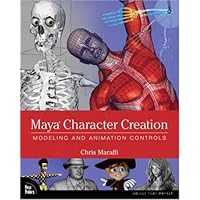
Maya Character Creation: Modeling and Animation Controls Review

Maya Character Creation: Modeling and Animation Controls
Average Reviews:

(More customer reviews)
First impressions. A quick glance through the book reveals that this book is for beginning to intermediate Maya users. It includes all one needs to know about character modeling and preparing the model for animation from modeling to skeleton setup to skinning to scripting. Actual character animation itself is not covered in this book.
The book is illustrated with many sketches and screenshots but the illustrations are not in color which makes some of the screenshots hard to see especially the ones with wireframe models.
As the book concentrates on character setup, the examples and tutorials in the book involve creating and working with fairly realistic characters that have muscle and bone structure. If you are only interested in creating highly stylized or simple characters for use in your animation then you won't find much that is useful in this book. If you want to create the next Gollum then read on.
The book starts off with some information on the evolution of digital characters in film. This is followed by an introduction on the basics of character modeling.
The next chapter is on modeling the skin of a biped character and this happens to be the biggest chapter in this book. It begins with an introduction on different modeling methods for modeling a head, usually the most difficult part to model. Here and in the rest of the book as well, the author explains carefully on the pros and cons of each method and possible associated pitfalls that might be encountered when the model is used in an animation later on. Most books on modeling do not take into consideration the problems that might arise later on when animating the model and character animation books usually concentrate on the animation aspects. The author of this book does a commendable job of getting both these bases covered.
This is followed by modeling of the torso and limbs. Later on, the multipatch character is converted into a polygon skin to simplify the process of adding details to the model. Last but not least this chapter covers skin texturing including the use of UV polygons.
There are exercises intersped within the chapters after every few section which covers in detail with step by step instructions on how to perform the lessons covered in the previous sections. Although the steps are explained carefully it would have been better if more accompanying screenshots had been included to guide the reader. As it is, great care has to be taken to read the text carefully as there is no graphical reference to compare if the steps have been followed correctly.
Chapter 3 is on character skeleton setup. This brings back memories of my biology classes as the author covers the importance of having a good understanding of the skeletal anatomy of the human body. Both Forward Kinematics (FK) and Inverse Kinematics (IK) are explained as is when each method is to be used. Pointers to naming convention is included.
All of the above is then employed to create a basic character rig. Controls are added to the rig using the Connection Editor, the Expression Editor or the set driven keys to simplify animation with samples and exercises for each method. Each method is covered in detail in this chapter.
Chapter 4 covers skin deformation with a process known as skin binding with focus on the smooth skin binding method. Muscle flexing using both muscle skeleton and influence objects are covered. For additional realism, methods on deforming the skin with bones, wrinkles and fat are given attention as well.
Face animation is up next. Because it's the most expressive part of the body, special attention has to be given to the animation controls in this area. Techniques such as morph targets and using influences to mimic facial muscles are included as well.
The next chapter is on scripting controls using Maya Embedded Language, something that most Maya users including myself, find daunting. Only the basics are covered with a little information on what advanced scripting can do. Although this chapter only scratches the surface on MEL, it serves it's purpose of whetting the reader's appetite for more information.
The book ends with some guidelines on finishing touches like cleaning up and optimizing the character controls. Some animation methods are also covered and lastly, readers learn how to simplify and streamline animation by using multiple rigs of varying complexity.
Overall, the book is informative and would be a valuable asset to it's targeted audience, beginning to intermediate level Maya users who want to learn about character modeling and setting up the models for animation. The exercises are detailed enough but illustrations and the use of colors are a bit lacking.
The author's style of writing is easy to comprehend and I liked the way how each chapter is nicely summarized at the beginning of each chapter with an indication of what the reader can hope to accomplish at the conclusion of the chapter.

Click Here to see more reviews about: Maya Character Creation: Modeling and Animation Controls

A unique, in-depth approach to creating realistic characters in Maya. Maya Character Creation: Modeling and Animation Controls' author, Chris Maraffi, has expertise in the field and in the classroom that translates to the knowledge and solid teaching skills needed to make this book a "must-have"!The current trend in computer graphics is greater organic realism. Many of thetop-grossing movies today, such as Spiderman, Lord of the Rings, Jurassic Park 3 ,and Star Wars Episode 2, all feature realistic 3D characters. There is a majorneed in the 3D community for educational material that demonstrates detailedtechniques for achieving this organic reality. Maya is one of the main packagesused on such cutting-edge films, and has an established toolset for creatingbelievable 3D characters. Maya Character Creation: Modeling and Animation Controls is designed to take you through the process of designing, modeling, and setting up animation controls for complex 3D characters. The concepts, techniques, and Maya tools used foreach step in the process are presented in each chapter, followed by manyhands-on exercises. NURBS, polygon, and subdivision surface modelingtechniques are shown for creating the character's skin, and skeleton-basedanimation controls are covered in detail. You will learn how a character'sskin should deform when the skeletal joints and muscles move. AdvancedMEL scripted animation controls are also covered extensively.

Buy NowGet 32% OFF

Click here for more information about Maya Character Creation: Modeling and Animation Controls

Read More...

Database Modeling and Design, Fifth Edition: Logical Design (The Morgan Kaufmann Series in Data Management Systems) Review

Database Modeling and Design, Fifth Edition: Logical Design (The Morgan Kaufmann Series in Data Management Systems)
Average Reviews:

(More customer reviews)
I have to underscore a statement in the preface with which I am in total agreement: "This book can . . . be used by the advanced undergraduate or beginning graduate student to supplement a course textbook in introductory database management . . ." In fact, the authors point out that the fifth edition of this book has been split into a second work, PHYSICAL DATABASE DESIGN: THE DATABASE PROFESSIONAL'S GUIDE, 1st edition (a title that is not in print at the time of this review). As a book about "Logical Design," explaining WHY (not HOW) is the strength of the work. This is not a book one would primarily rely upon for developing an application. But it is an excellent work for giving solid background in the underpinnings of database design. The HOW (as the author's stated) is spawned off in another work, in this case.
I'm a non-professional IT person who has designed and implemented dozens of LAMP (Linux-Apache-MySQL-php) applications, and database design activities dating back to the 1980's, primarily in the honorable environment of the various MS-DOS flavors of the day. All of this with zero formal training (which isn't the same as NO training). With that background in mind, after going through this book I confirmed that I had picked up a lot of bad habits and developed a lot of good practices. My worst habit? A preference for flat databases over relational ones (see Chapter 8 - Object-Relational Design). My hardest earned (and confirmed by this book) good practice? The absolute importance of "requirements analysis," or, rigorous interviewing of the end user population to "determine exactly what the database is to be used for . . ." (see Chapter 4 - Requirements Analysis and Conceptual Data Modeling). In both of these cases this book was excellent in explaining WHY.
Since I work almost exclusively with web based databases now, I found Chapter 9 (XML and Web Databases) to contain one of the most concise and elegant explanations of XML I've ever read.
One annoying, but not fatal, flaw of this work: the quite serviceable index appears before the appendices, instead of the almost universal location of the last section of the book. I.e., when I turned to the back of the book to use the index, it wasn't where I expected. After a little fumbling, I did find it, but this is, in my opinion, a logical design flaw of the book.
I wouldn't hesitate to recommend this book as a purchase to an undergraduate MIS student even if it isn't a class requirement. This is a good book to develop a solid conceptual foundation. Also, since this book is primarily conceptual in its focus, it should have a shelf life much longer than works which focus on specific hardware and software which evolve continuously. Most of the concepts described in this book would have been relevant to me in my MS-DOS database days.

Click Here to see more reviews about: Database Modeling and Design, Fifth Edition: Logical Design (The Morgan Kaufmann Series in Data Management Systems)

Database systems and database design technology have undergone significant evolution in recent years. The relational data model and relational database systems dominate business applications; in turn, they are extended by other technologies like data warehousing, OLAP, and data mining. How do you model and design your database application in consideration of new technology or new business needs? In the extensively revised fifth edition, you'll get clear explanations, lots of terrific examples and an illustrative case, and the really practical advice you have come to count on--with design rules that are applicable to any SQL-based system. But you'll also get plenty to help you grow from a new database designer to an experienced designer developing industrial-sized systems.
In-depth detail and plenty of real-world, practical examples throughout

Loaded with design rules and illustrative case studies that are applicable to any SQL, UML, or XML-based system


Immediately useful to anyone tasked with the creation of data models for the integration of large-scale enterprise data.


Buy NowGet 10% OFF

Click here for more information about Database Modeling and Design, Fifth Edition: Logical Design (The Morgan Kaufmann Series in Data Management Systems)

Read More...

8/23/2011

Parametric Modeling with Autodesk Inventor 2011 Review

Parametric Modeling with Autodesk Inventor 2011
Average Reviews:

(More customer reviews)
This book was very informative and I got a lot out of it. I received it faster than I thought I would. KudoS!!!!

Click Here to see more reviews about: Parametric Modeling with Autodesk Inventor 2011

Parametric Modeling with Autodesk Inventor 2011 contains a series of fifteen tutorial style lessons designed to introduce Autodesk Inventor, solid modeling, and parametric modeling. It uses a hands-on, exercise-intensive approach to all the import parametric modeling techniques and concepts. The lessons guide the user from constructing basic shapes to building intelligent mechanical designs, creating multi-view drawings and assembly models. Other featured topics include sheet metal design, motion analysis, 2D design reuse, collision and contact, and the Autodesk Inventor 2011 Certified Associate Examination.
Table of Contents1. Getting Started 2. Parametric Modeling Fundamentals 3. Constructive Solid Geometry Concepts 4. Model History Tree 5. Parametric Constraints Fundamentals 6. Geometric Construction Tools 7. Parent/Child Relationships and the BORN Technique 8. Part Drawings and Associative Functionality 9. Datum Features and Auxiliary Views 10. Symmetrical Features in Designs 11. Advanced 3D Construction Tools 12. Sheet Metal Design 13. Assembly Modeling - Putting It All Together 14. Content Center and Basic Motion Analysis 15.2D Design Reuse, Collision and Contact

Buy NowGet 43% OFF

Click here for more information about Parametric Modeling with Autodesk Inventor 2011

Read More...