1/26/2013

Making More Wooden Mechanical Models Review

Making More Wooden Mechanical Models
Average Reviews:

(More customer reviews)
The authors have done it again, an inspirational book for woodworkers. Their are 13 designs of maechanisms which can be made in a workshop with basic woodworking tools. They tell you what they are and how they work. The projects range from easy to make to a little more difficult. They give you working drawings and templates, picture to show you step by step procedure, suggestions for choosing the wood, and each project is beautifully photographed which will inspire you to get started on such projects as a Steam Crank Mechanism,Wheel and Worm Gear Mechanism and more. These projects and the ones in their previous book would make great teaching aids for those who teach mechanical design. The one criticizm I have is that I am accustomed to working with dimentional drawings and not templates.This book is a pleasure just to page through and even a greater pleasur to get started on one of the machines and see it develop from scratch and then to operate it.

Click Here to see more reviews about: Making More Wooden Mechanical Models

Mechanical models are always a favorite at woodworkingshows, catching the attention of countless woodworkers who like tomake these ingenious pieces come alive. Despite their seeminglyelaborate configurations, these projects are surprisingly simple tomake following this guide's complete step-by-step instructions.Everyproject features a full-color close up of the drawings, cutting listsand special tips for making difficult steps easier.

Buy Now

Click here for more information about Making More Wooden Mechanical Models

Read More...

1/25/2013

Model-Making: Materials and Methods Review

Model-Making: Materials and Methods
Average Reviews:

(More customer reviews)
This is an excellent choice for artists or designers in the areas of theatre production or film production.

Click Here to see more reviews about: Model-Making: Materials and Methods

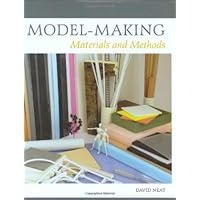
Models can be used in a wide variety of situations, including theater production, architecture design, animation, and set design. For each different situation a specific material is often preferable, and this handy guide addresses the best model-making materials, from the standard and traditional to the new and innovative. Tips are provided on how each of the materials behaves and how best to use them, and illustrated instructions demonstrate methods of building, shaping, surfacing, and painting each material. A number of examples are also included along with step-by-step accounts of what materials were used and how they were manipulated without the need for expensive tools or workshop facilities. A directory covering the full range of materials involved in model-making together with an extensive list of suppliers complete this essential resource.

Buy NowGet 30% OFF

Click here for more information about Model-Making: Materials and Methods

Read More...

An Introduction to Data Structures and Algorithms (Progress in Theoretical Computer Science) Review

An Introduction to Data Structures and Algorithms (Progress in Theoretical Computer Science)
Average Reviews:

(More customer reviews)
If you have cut your teeth on Donald Knuth's classic three volumes, "The Art of Computer Programming", and you want more detail, at a similar level of complexity, then consider Storer's book.
It delves into lists, recursion, trees, graphs, heaps and sets. Like Knuth, Storer thoughtfully supplies an extensive list of questions at the end of each chapter that will greatly deepen your appreciation of the field if you tackle them. Ok, he doesn't give answers, but think of that as greater incentive on your part to solve them. There are almost 400 questions in the book.
The teaching style is similar to Knuth, in that it has all the rigour needed by an algorithm designer like yourself, without drowning you in epsilon-delta ultra rigour like a pure maths text.
Note that the only code fragments are in pseudocode. This should not be a problem for you. I am assuming you are experienced enough that what you need is understanding of an algorithm, and that manually converting it to code is straightforward and a purely secondary issue.
The take home message is that this is excellent for anyone doing serious programming.

Click Here to see more reviews about: An Introduction to Data Structures and Algorithms (Progress in Theoretical Computer Science)

Data structures and algorithms are presented at the college level in a highly accessible format that presents material with one-page displays in a way that will appeal to both teachers and students. The thirteen chapters cover: Models of Computation, Lists, Induction and Recursion, Trees, Algorithm Design, Hashing, Heaps, Balanced Trees, Sets Over a Small Universe, Graphs, Strings, Discrete Fourier Transform, Parallel Computation. Key features: Complicated concepts are expressed clearly in a single page with minimal notation and without the "clutter" of the syntax of a particular programming language; algorithms are presented with self-explanatory "pseudo-code." * Chapters 1-4 focus on elementary concepts, the exposition unfolding at a slower pace. Sample exercises with solutions are provided. Sections that may be skipped for an introductory course are starred. Requires only some basic mathematics background and some computer programming experience. * Chapters 5-13 progress at a faster pace. The material is suitable for undergraduates or first-year graduates who need only review Chapters 1 -4. * This book may be used for a one-semester introductory course (based on Chapters 1-4 and portions of the chapters on algorithm design, hashing, and graph algorithms) and for a one-semester advanced course that starts at Chapter 5. A year-long course may be based on the entire book. * Sorting, often perceived as rather technical, is not treated as a separate chapter, but is used in many examples (including bubble sort, merge sort, tree sort, heap sort, quick sort, and several parallel algorithms). Also, lower bounds on sorting by comparisons are included with the presentation of heaps in the context of lower bounds for comparison-based structures. * Chapter 13 on parallel models of computation is something of a mini-book itself, and a good way to end a course. Although it is not clear what parallel

Buy NowGet 48% OFF

Click here for more information about An Introduction to Data Structures and Algorithms (Progress in Theoretical Computer Science)

Read More...

1/24/2013

An Introduction to Programming with IDL: Interactive Data Language Review

An Introduction to Programming with IDL: Interactive Data Language
Average Reviews:

(More customer reviews)
Nothing is more intimidating to a new user of IDL than to sit down at a computer with an empty command line prompt and a stack of manuals on their desk and be told to write an IDL program. Where to begin!? And the experience is especially frightening to a new user with little or no programming experience in any language, let alone IDL.
Ken Bowman has written an IDL book specifically for this user. It is intended as an introductory computer programming course for the research user with little or no training in any computer language, and it evolved from notes Ken uses in his own undergraduate IDL programming courses. It is meant to get the new IDL user analyzing and plotting data as soon as possible.
It is a narrow path he treads, because it is just as easy to offer too much detail as it is to offer too little information to the beginning user. Ken, for the most part, gets it exactly right in covering a broad selection of topics. I quibble with just two chapters. He sweeps aside the complexity of PostScript output by offering the new user two utility programs he fails to explain in the text, and his theoretical explanation of the FFT function left me gasping for breath and lamenting I hadn't paid closer attention in those long-ago math classes.
This is a book that will get you started, but probably won't answer all your questions when you turn your attention to more difficult research problems. Ken doesn't pretend it is anything other than what it is, however, and provides generous and helpful suggestions for where you can find additional information as you become ready for it. Readers already familiar with another programming language will appreciate this introduction to IDL, but might become frustrated with the slower pace and lack of specific detail on many topics.
The book has an associated web page, where you can find, among other things, the source code for all the programs mentioned in the book. Pay particular attention to the Errata section, especially if you are interested in structures in IDL. A printer glitch removed all the curly brackets from Ken's IDL code in the structure chapter and none of the examples will work as written in the book. A software problem, no doubt. (The example programs for the chapter are correct.) It serves as a reminder to me of how complex a topic software programming can be. This friendly book will be a welcome introduction to the subject for many a potential IDL programmer.

Click Here to see more reviews about: An Introduction to Programming with IDL: Interactive Data Language

In today's information age, scientists and engineers must quickly and efficiently analyze extremely large sets of data. One of the best tools to accomplish this is Interactive Data Language (IDLÂ), a programming and visualization environment that facilitates numerical modeling, data analysis, and image processing.IDL's high-level language and powerful graphics capabilities allow users to write more flexible programs much faster than is possible with other programming languages.An Introduction to Programming with IDL enables students new to programming, as well as those with experience in other programming languages, to rapidly harness IDL's capabilities: fast, interactive performance; array syntax; dynamic data typing; and built-in graphics. Each concept is illustrated with sample code, including many complete short programs. ÂMargin notes throughout the text quickly point readers to the relevant sections of IDL manualsÂEnd-of-chapter summaries and exercises help reinforce learningÂStudents who purchase the book are eligible for a substantial discount on a student version of the IDL software

Buy NowGet 39% OFF

Click here for more information about An Introduction to Programming with IDL: Interactive Data Language

Read More...

A Manager's Guide to Database Technology: Building and Purchasing Better Applications Review

A Manager's Guide to Database Technology: Building and Purchasing Better Applications
Average Reviews:

(More customer reviews)
"A Manager's Guide to Database Technology" provides a straightforward introduction and overview of important database concepts. Utilizing real-life scenarios, this book highlights the importance of databases and database technology.
Databases in general will play an increasingly important role in our increasingly digital world, in my opinion. Along these lines, I recommend this book as a good primer for a wide audience to the field of database technology.

Click Here to see more reviews about: A Manager's Guide to Database Technology: Building and Purchasing Better Applications

This is a start-to-finish decision-maker's guide to making the most of database technology: from selecting the right product through optimizing performance, and beyond. In non-technical, highly accessible language, this book helps business decision-makers master all the database strategies, applications, principles, and paradigms they need to understand -- regardless of their previous experience with databases. Managers will discover where databases fit in the enterprise and in the IT infrastructure; how databases can best be architected to meet changing business requirements; and how to compare and choose among competitive offerings. Then, they'll walk step-by-step through the database development process, learning project management techniques that deliver maximum business value in the shortest time. A Manager's Guide to Database Technology even includes detailed briefings on the latest advances in the field, including distributed and object-oriented databases.

Buy NowGet 27% OFF

Click here for more information about A Manager's Guide to Database Technology: Building and Purchasing Better Applications

Read More...

1/23/2013

Microsoft® SQL Server(TM) 2000 Analysis Services Step by Step (DV-DLT Fundamentals) Review

Microsoft® SQL Server(TM) 2000 Analysis Services Step by Step (DV-DLT Fundamentals)
Average Reviews:

(More customer reviews)
This Step by Step guide serves as a great starting point for getting familiar with Microsoft's Analysis services. It starts with a quick introduction to data warehousing (without resorting to giving an entire history of the subject, as seems so common today) and how it relates to OLAP and then moves right into the Analysis Servies tools.
The chapters are well written and get you the information you need, without missing any major details. Even if you don't plan to take the "step by step" approach, this book is worth having by your side.
All right... now for the downsides. At best this book is good for beginners. These are some of the areas where I found it came up short:
- Sizing systems that will support Analysis Services. The book talks a bit about how big cubes are, but there is no information about cube performance/cube sizing, etc. Basically, this book won't help you develop a hardware plan for hosting Analysis Services.
- Accessing Analysis Services via the web. All of Microsoft's literature talks about how SQL Server 2000's great support for the web/XML. Strangely, it is very hard to find this information for Analysis Services, and this book doesn't provide any guidance. Right now it seems that the best you can do to find this information is hunt around Microsoft's site.
Overall I still think this is good book. However, if you are going to be building a large Analysis Services system, expect to be looking for other sources to answer all of your questions.

Click Here to see more reviews about: Microsoft® SQL Server(TM) 2000 Analysis Services Step by Step (DV-DLT Fundamentals)


MICROSOFT® SQL SERVER™ 2000 ANALYSIS SERVICES STEP BY STEP shows Microsoft Excel and Access experts, IS managers, and database developers how to build applications that take advantage of the powerful data-analysis services in Microsoft SQL Server 2000. You'll discover why these services make it easier to analyze huge amounts of data quickly, and you'll learn how to develop a wide range of advanced dimensional-data applications-from enterprise reporting tools to advanced decision-support systems. The book's easy-to-follow lessons begin with clear objectives and include real-world business examples, with a companion CD full of sample files that support each lesson.

This title shows you how to:

Administer the Analysis Manager: Understand the fundamentals behind data dimensions and hierarchies, data warehousing, and the Microsoft Analysis Services architecture, and use the Microsoft Analysis Manager application to define and populate data cubes.
Create and display cubes: Define and modify measures and dimensions. Design, build, process, and view cubes, from simple to advanced, with cube and dimension editors. Use Microsoft Excel PivotTable® Reports and the PivotTable List in Microsoft Excel to browse cubes, and create cubes using Microsoft Office.
Query cubes: Use multidimensional expressions (MDX) values and sets and the MDX Sample application to query and display dimensional data.
Perform advanced administration: Choose data storage options and the Storage Design Wizard to optimize, manage, and update data efficiently. Automate the Analysis server to process an OLAP database. Work with partitions and automate updates, and apply security to cubes.

A Note Regarding the CD or DVD

The print version of this book ships with a CD or DVD. For those customers purchasing one of the digital formats in which this book is available, we are pleased to offer the CD/DVD content as a free download via O'Reilly Media's Digital Distribution services. To download this content, please visit O'Reilly's web site, search for the title of this book to find its catalog page, and click on the link below the cover image (Examples, Companion Content, or Practice Files). Note that while we provide as much of the media content as we are able via free download, we are sometimes limited by licensing restrictions. Please direct any questions or concerns to booktech@oreilly.com.


Buy Now

Click here for more information about Microsoft® SQL Server(TM) 2000 Analysis Services Step by Step (DV-DLT Fundamentals)
Read More...

Business Analysis Review

Business Analysis
Average Reviews:

(More customer reviews)
I've been recently transitioned asa business analyst at work and have been combing through all sorts of BA material to learn more about my new field. I've been through at least 7 different BA books and this one is by far my favorite. I keep it with me all the time... it's a great reference book. It also presents the material in an easy and understandable way. I highly recommend this book to any business analyst... new or seasoned.

Click Here to see more reviews about: Business Analysis

Improving the effectiveness of your IT through better alignment with the business is a precursor to increasing profitability. This practical, introductory guide provides you with the tools to achieve this. It teaches you about strategy analysis and how to model business systems and processes and covers other topics including business case development, change management, and engineering/information resource management. The book also supports the ISEB qualifications in Business Analysis.

Buy NowGet 13% OFF

Click here for more information about Business Analysis

Read More...